Blog / Essay
The Road to General-Purpose Robotics Is Not General-Purpose
The three paradoxes of general-purpose robotics: why building intelligent robots and building a successful robotics company are two very different problems.
There has never been more excitement around general-purpose robotics. Foundation models, vision-language-action models, world models, and large-scale imitation learning are fundamentally changing how we approach robotic intelligence.
The prevailing belief is that robotics will follow a similar trajectory to language models: collect more data, train larger models, and eventually achieve general-purpose intelligence.
I believe in this technological direction. But unlike language models, robots have to operate in the physical world. The physical world introduces constraints that cannot simply be scaled away with more compute.
Looking at the current robotics industry, I see three fundamental paradoxes standing between technological progress and large-scale adoption.
1.The Data Paradox: You Need Deployment to Get Data, and Data to Get Deployment
The modern AI playbook is relatively straightforward: collect data, train models, deploy them, collect feedback, and repeat.
In robotics, however, this flywheel is incredibly difficult to start.
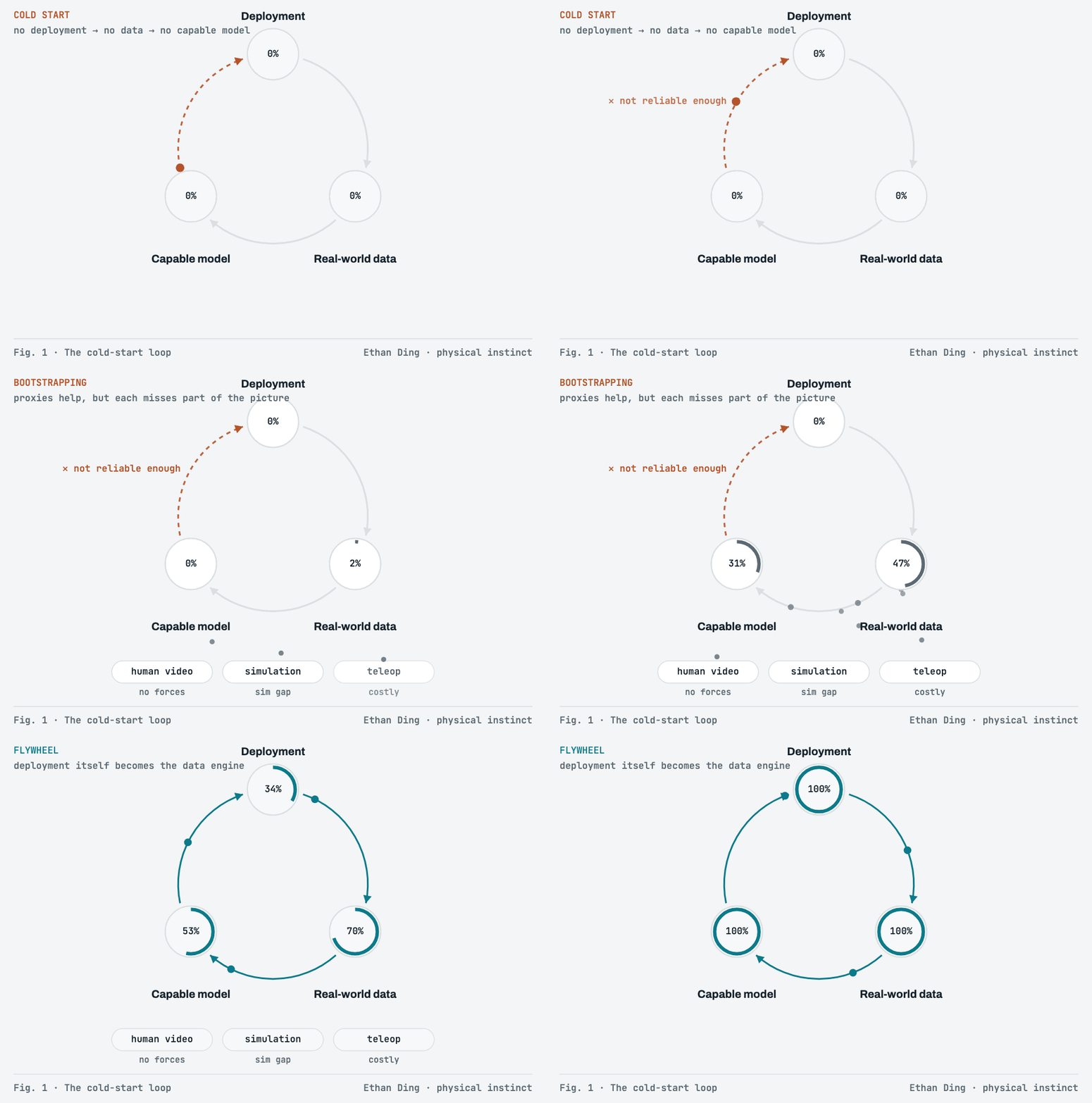
Robotics foundation models need diverse, high-quality data from real-world interactions. But collecting this data at scale requires deploying robots into real environments. And deploying robots into real environments requires models that are already sufficiently capable and reliable.
Without deployment, there is no scalable data engine. Without a scalable data engine, there is no sufficiently capable model.
This is the robotics cold-start problem.
Language models benefited from decades of human-generated digital content. The internet existed long before modern AI, and it effectively became an enormous, pre-existing dataset.
Robotics has no equivalent of the internet for physical interaction.
Human video, simulation, teleoperation, synthetic data, and world models can all help bridge this gap. But each captures a different subset of what robots ultimately need to learn.
A video shows what happened, but not necessarily the forces involved. A simulator provides controllable interactions, but introduces its own distribution gap. Teleoperation produces actionable trajectories, but remains expensive and operationally demanding.
Ultimately, some of the most valuable robotics data comes from robots actually doing useful work in the real world.
The implication is that robotics companies cannot simply treat deployment as something that happens after the model is ready.
Deployment itself needs to become part of the training infrastructure.
The winning robotics data engine may not be the one that collects the most demonstrations in a laboratory. It may be the one that turns every customer deployment, every intervention, and every failure into a continuous source of learning.
2.The Value Paradox: The Most Valuable Tasks Often Require the Least Generalization
The fundamental promise of general-purpose robotics is generalization.
Instead of engineering a separate system for every task, we want a single model that can manipulate different objects, operate in unfamiliar environments, and adapt to new instructions.
Technologically, this is extremely compelling.
Commercially, the picture is more complicated.
Many of the most attractive automation opportunities share a few characteristics:
- High task frequency.
- Predictable environments.
- Standardized workflows.
- Measurable return on investment.
- Large and recurring labor costs.
These characteristics also make the tasks easier to solve with specialized automation.
If a robot performs the same operation ten thousand times a day, the customer may not care whether it understands natural language, can fold laundry, or has an internal representation of the physical world.
The customer cares about throughput, reliability, uptime, and cost.
Meanwhile, the environments that genuinely demand generalization — households, small businesses, unstructured workplaces, and long-tail manipulation tasks — are often much harder to monetize.
Their workflows are less predictable, their deployment costs are harder to amortize, and their reliability requirements are difficult to satisfy.
This creates an uncomfortable tension:
The tasks that are easiest to monetize often require the least intelligence, while the tasks that require the most intelligence are often the hardest to monetize.

Of course, this does not mean general-purpose models have no commercial value.
Generalization can dramatically reduce the engineering cost of deploying robots across different customers, facilities, objects, and workflows.
Perhaps the most valuable form of generalization, at least in the near term, is not performing a thousand completely different tasks.
It is performing the same economically valuable task across a thousand different environments without requiring a thousand separate engineering projects.
That is a very different product philosophy from building a robot that can do everything.
Generalization should not necessarily be the product being sold. It can be the underlying technology that makes the product scalable.
3.The Talent Paradox: The People Who Build Robots Are Not Necessarily the People Who Deploy Them
The current wave of robotics startups is largely driven by progress in AI research.
Many founders and early employees come from machine learning labs, academic institutions, or frontier AI companies. They are exceptionally good at developing new architectures, training large models, and improving benchmark performance.
But deploying robots is a fundamentally different kind of work.
It means visiting factories and warehouses.
It means debugging hardware at midnight because a customer needs the production line running the next morning.
It means dealing with broken cables, unstable networks, worn-out grippers, calibration errors, unexpected objects, safety requirements, and workflows that were never documented.
It means discovering that the elegant solution you developed in a controlled laboratory does not survive contact with a messy industrial environment.
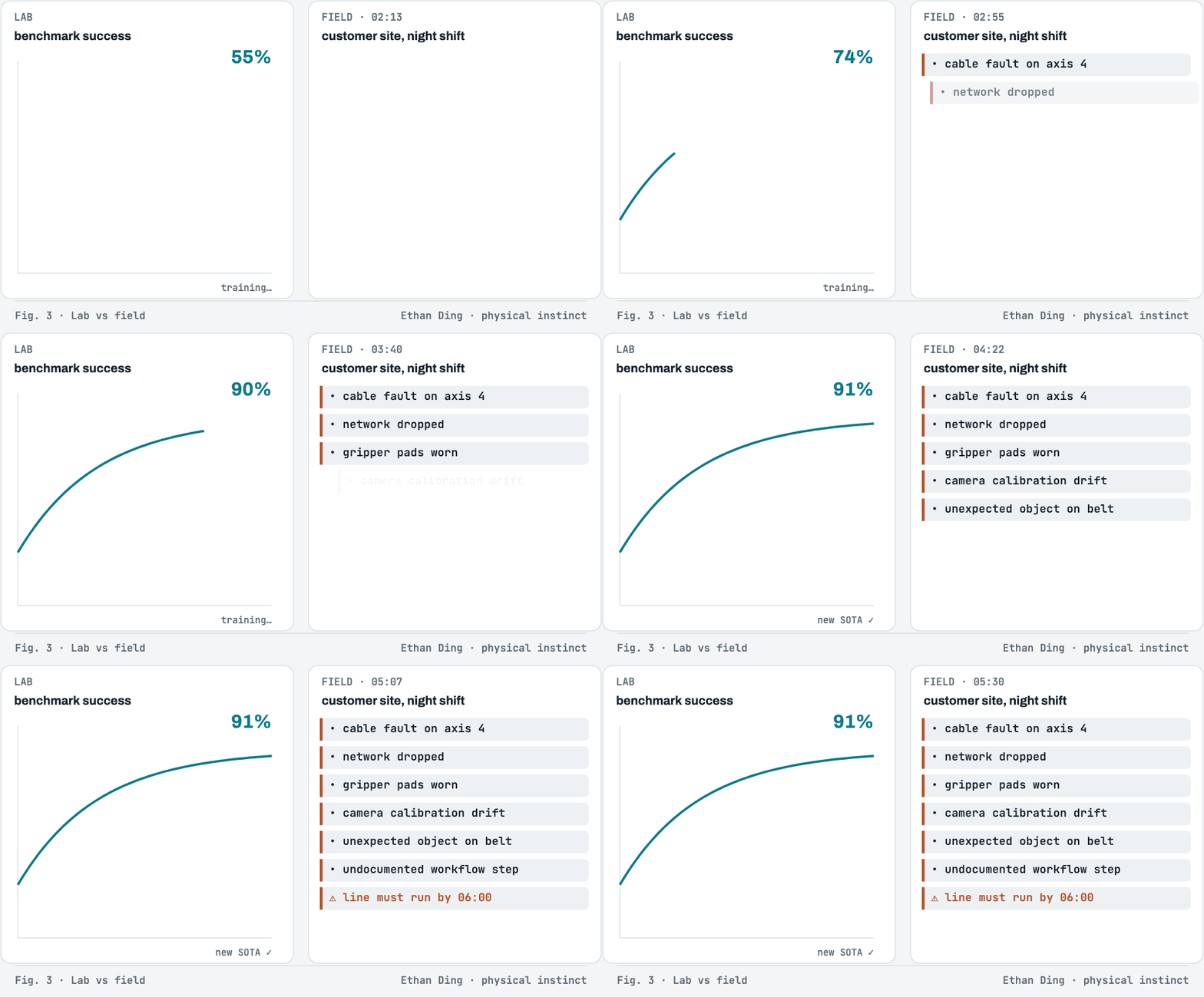
A significant portion of robotics commercialization is not glamorous AI research. It is dirty, repetitive, operationally intensive work.
And there is a mismatch between the type of talent attracted to frontier robotics research and the type of work required to build a successful robotics business.
In software, a small team can often build a product from an office and distribute it globally over the internet.
In robotics, the product physically exists in the customer's environment. You cannot simply push a software update and assume the entire system will work.
The hardware, software, environment, and human workflow are all part of the product.
This is why I believe the organizational structure of a successful robotics company will look quite different from that of a pure AI research company.
It needs world-class AI researchers, but also exceptional hardware engineers, systems engineers, field engineers, and operators.
More importantly, deployment cannot be treated as a second-class function that exists merely to support research.
Field operations are where the company discovers what actually matters.
The best robotics companies will find ways to systematically turn operational pain into engineering improvements, and engineering improvements into learning signals.
Breaking the Three Paradoxes
These three paradoxes are not independent. They reinforce each other.
Without commercially viable use cases, there is no sustainable deployment.
Without deployment, there is no scalable real-world data engine.
Without real-world data, models struggle to become sufficiently capable.
Without a team willing to handle the operational complexity of deployment, the entire flywheel remains theoretical.
I think a more practical approach to general-purpose robotics starts with three principles.
Start with a narrow problem, but build a generalizable system.
A robotics company's first product does not need to be general-purpose.
It needs to create real economic value.
Start with a problem where customers are willing to pay, where performance can be measured, and where robots can accumulate meaningful interaction experience.
The underlying system, however, should be designed to transfer across objects, environments, and eventually tasks.
Commercial specialization and technological generalization are not contradictory.
In fact, specialization may be the most sustainable path toward generalization.
Make deployment the data engine.
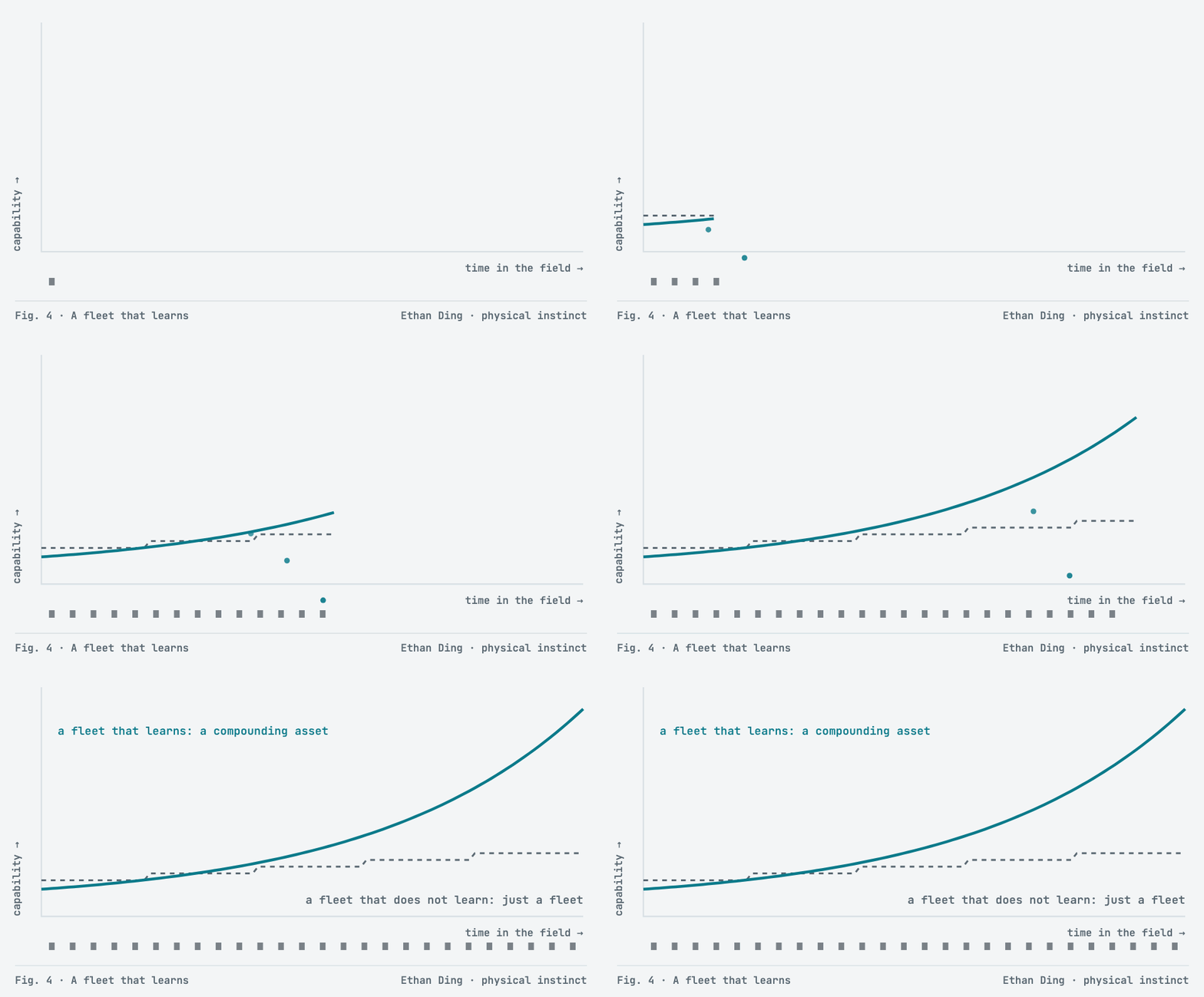
Every robot in the field should contribute to improving the next generation of robots.
Human interventions, failed attempts, environmental variations, and successful executions should become learning signals.
The objective is not merely to increase the number of deployed robots. It is to increase the amount of useful learning generated by each deployed robot.
A fleet that does not learn is simply a fleet. A fleet that continuously improves is a compounding technological asset.
Make operational complexity a competitive advantage.
Many technology companies try to avoid operationally intensive businesses.
In robotics, some of that operational complexity may actually be the source of a durable competitive advantage.
Understanding customer workflows, building reliable hardware-software systems, collecting proprietary interaction data, and establishing field deployment capabilities are difficult to replicate.
The challenge is to ensure that this operational knowledge is progressively absorbed into the technology, rather than permanently scaling through human labor.
Otherwise, a robotics company risks becoming a systems integration business with an AI research department.
The goal should be for every difficult deployment to make the next deployment easier.
The Road to General-Purpose Robotics May Not Be General-Purpose
I remain optimistic about the long-term potential of robotic foundation models.
But I am less convinced that the path to general-purpose robotics will look like the path to large language models.
We may not be able to train a sufficiently intelligent robot first and figure out what to do with it later.
Instead, intelligence may have to emerge through a long process of solving real problems, deploying imperfect systems, collecting data, and gradually expanding the boundary of what robots can do.
The industry often frames the race in terms of who has the largest model, the most GPUs, or the most impressive demonstration.
I suspect the more important questions are:
Who can deploy profitably?
Who can learn most efficiently from deployment?
And who can turn that learning into increasingly general capabilities?
The ultimate winner may not be the company with the smartest robot today, but the company whose robots get smarter every day while doing economically useful work.
General-purpose robotics may be the destination. But specialization, deployment, and a willingness to do the dirty work may be the road that gets us there.